
Vertical AI
India’s Smartest AI Opportunity

The biggest opportunity for Indian AI founders is in building Vertical AI systems that deeply understand a single industry through proprietary data, domain expertise and real-world workflows.
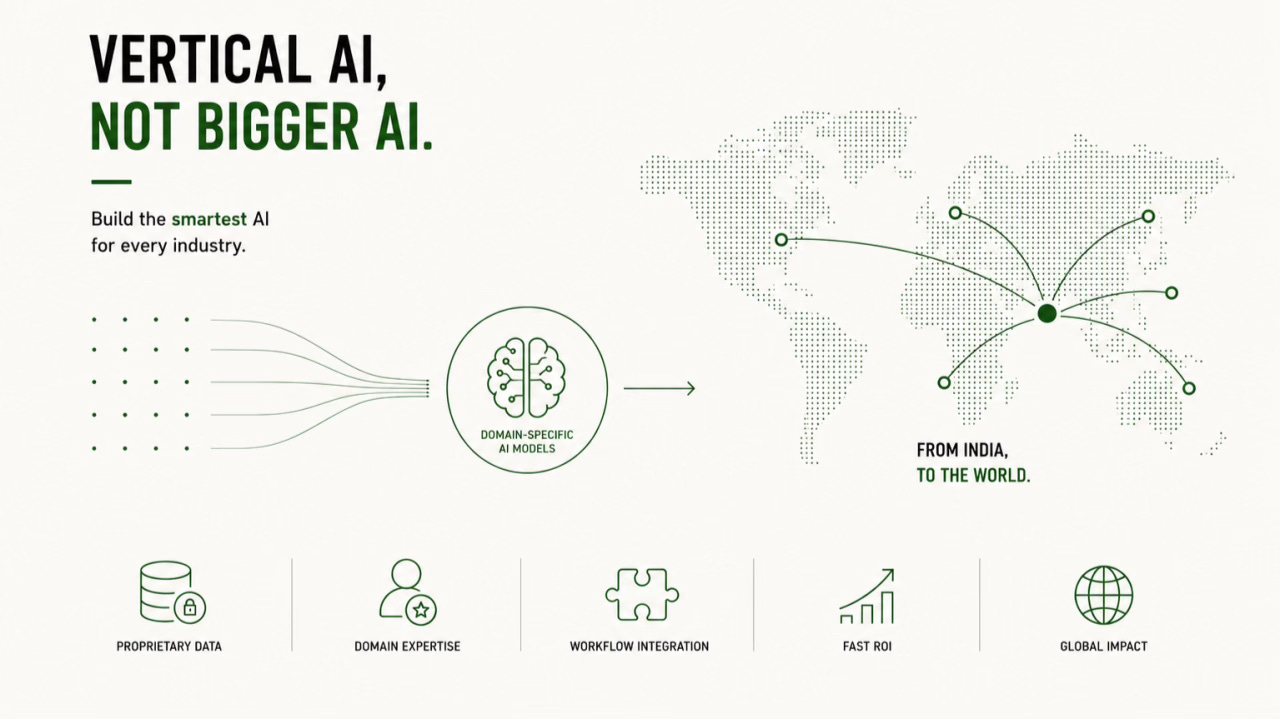
India doesn’t need another ChatGPT.
Our biggest AI opportunity is building Vertical AI—AI systems designed for a single industry and deeply integrated into its workflows.
While the race to build frontier foundation models demands billions of dollars, massive compute and years of research, Vertical AI is a different game. Success comes from understanding an industry better than anyone else, training models on proprietary data and embedding them into real business operations.
With 1.4 billion people, one of the world’s largest digital economies and deep expertise across industries like healthcare, manufacturing, finance, agriculture and legal services, India is uniquely positioned to build these systems.
The opportunity isn’t to compete with OpenAI and Anthropic to build frontier models but to outperform their models in specific use cases.
It’s to build the AI that hospitals, insurers, manufacturers, banks and governments rely on every day.
That’s where India’s next generation of AI companies and intellectual property will be created.
Why India Has an Advantage
Every country has its strengths.
The US has frontier AI research, access to enormous capital and some of the world’s largest compute infrastructure.
Taiwan dominates semiconductor manufacturing.
South Korea built world-leading electronics companies.
India’s advantage is different.
We have one of the world’s largest user bases, millions of businesses, and an incredible diversity of real-world workflows.
That gives us something equally valuable: proximity to problems.
Every day, hospitals generate clinical data.
Factories optimize production.
Banks process millions of transactions.
Insurance companies settle claims.
Governments deliver public services at enormous scale.
These aren’t just industries.
They’re opportunities to build AI that understands their workflows better than any general-purpose model ever could.
Economics Favour Vertical AI
Building a frontier LLM has become one of the most capital-intensive technology projects in history.
Training costs now run into tens or even hundreds of millions of dollars, excluding ongoing infrastructure and inference costs.
Today, that race is realistically limited to a handful of companies with exceptional access to capital and compute.
Vertical AI changes the economics.
Instead of training a model that knows everything, companies can build models that know one industry exceptionally well.
They can start with open-source foundation models, fine-tune them on proprietary datasets, integrate them into enterprise workflows and create value much faster.
The barrier isn’t compute.
It’s domain expertise.
Where the Real IP Lives
Many people assume the model itself is the moat.
It usually isn’t.
The real moat is the combination of:
Proprietary industry data
Deep domain expertise
Workflow integration
Customer relationships
Continuous feedback loops
Anyone can download an open-source model.
Very few companies have years of hospital records, manufacturing data, insurance claims or legal documents that can continuously improve an AI system.
That’s the intellectual property that compounds over time.
How Vertical AI Companies Will Be Built
The opportunity isn’t for every company to build its own LLM.
The opportunity is for one company to build the best AI for an entire industry.
Imagine:
• A healthcare model that hospitals around the world trust for clinical documentation and decision support.
• A manufacturing model that optimizes production across thousands of factories.
• An insurance model that automates underwriting and claims processing.
• A legal model that understands regulations, contracts and compliance.
Each becomes the intelligence layer for its industry.
Instead of selling software to consumers, these companies sell AI infrastructure to enterprises.
Distribution Matters More Than the Model
These businesses don’t need viral consumer adoption.
Their customers are enterprises.
Hospitals.
Banks.
Manufacturers.
Insurance companies.
Governments.
The winning companies won’t necessarily have the smartest models.
They’ll have the best distribution, the deepest integrations and the strongest customer relationships.
The AI becomes invisible.
It simply makes every workflow faster and better.
This Is Already Happening
We’re already seeing early signs of this shift.
Healthcare AI is being trained on local clinical workflows and multilingual patient interactions.
Financial institutions are deploying AI for underwriting, fraud detection and compliance.
Manufacturers are using AI for predictive maintenance and quality control.
Agriculture companies are building multilingual assistants that help farmers make better decisions.
These aren’t generic chatbots.
They’re Vertical AI products designed for a single industry.
Challenges
Vertical AI isn’t easy.
It depends on access to high-quality proprietary data.
It requires deep domain knowledge.
Enterprise sales cycles are long.
Privacy, regulation and trust matter far more than in consumer AI.
But these are execution challenges—not technology limitations.
And they’re precisely the kinds of problems strong companies solve.
Build in India. Sell to the World.
Building for India doesn’t mean building only for India.
A healthcare AI developed in India can be deployed in hospitals across Europe, the Middle East or the US.
A manufacturing AI built for Indian factories can optimize production lines anywhere in the world.
The workflows change. The regulations differ.
But the underlying problems are remarkably similar.
The best Vertical AI companies won’t export because they’re Indian.
They’ll export because they’re simply the best at solving a specific problem.